
/ Guide
How long do motorcycle tyres last?
Most motorcycle tyres last five to seven years from manufacture, regardless of how much tread is left. Here's how to tell, what the law says, and why the date matters as much as the depth.
The honest answer is five to seven years from the date stamped on the sidewall. Not from when you bought it, not from when it was fitted. From manufacture.
A motorcycle tyre’s compound starts oxidising the day it leaves the factory, and once it’s hardened off, the grip never comes back. Tread depth is the easy thing to check. Age is the thing that catches people out.
This guide covers what age actually means in practice, the chemistry behind it, how to read the DOT date code, what UK MOT testers look for, the visible signs that say replace now, and how to store spares so they don’t age before you fit them.
How long do motorcycle tyres actually last?
Two clocks run on every tyre. You replace it when either runs out.
Tread life is the obvious one. Sport tyres might do 3,000 to 5,000 miles. Sport-touring rubber will do 8,000 to 12,000. A tough touring tyre on a heavy cruiser sometimes passes 15,000. Off-road and enduro tyres wear in hours, not miles. Track use is a separate conversation.
Calendar life is the one most riders ignore. Five to seven years from manufacture, regardless of mileage. The compound oxidises. The plasticisers that keep the rubber pliable migrate out. The tyre slowly turns into something that looks fine and behaves like an old eraser. Cold-tyre grip goes first. Wet grip goes next. A sunny B-road in July will hide a tired tyre for a long time. The first cold, damp morning tells you the truth.
Storage shifts that window in either direction. A bike that lives outside under a cover in coastal sun ages tyres faster than one in a dry, dark garage. A spare sat next to a battery charger ages faster still. Ozone from electrical equipment is a quiet killer.
Why tyres age — the actual chemistry
Three things are happening to the rubber from day one.
Oxidation. Oxygen molecules attack the long polymer chains that give rubber its elasticity. The chains break, then re-link in stiffer, shorter configurations. The end state is the same crumbly texture you see in a 15-year-old elastic band. Heat accelerates this exponentially. Roughly, every 10°C of average temperature doubles the rate.
Plasticiser migration. Modern motorcycle tyres are loaded with oils and waxes that keep the rubber pliable, manage tread-block flex and feed antiozonant compounds to the surface. Those additives don’t stay put. They slowly migrate out over months and years. A new tyre’s “sweat” of antiozonant on the sidewall is what protects the surface; once that supply runs down, surface cracking starts.
Antiozonant depletion. Ozone is the worst enemy of a stationary tyre. The waxy bloom you sometimes see on a new sidewall is sacrificial — it gets attacked by ozone before the structural rubber underneath. When the bloom is exhausted, ozone gets at the carcass directly. That’s where sidewall spider-webbing comes from.
None of this slows down because a tyre is on a shelf. The chemistry runs whether the wheel is turning or not. That’s why the DOT date matters more than the mileage.
Reading the DOT date code
Every road-legal tyre sold worldwide carries a DOT code. It’s stamped into the sidewall and ends with a four-digit number inside an oval. That’s the week and year of manufacture.
- First two digits: the week (01 to 53)
- Second two digits: the year
So 2823 is week 28 of 2023, late July. 0420 is week 4 of 2020, late January.
Two things to watch for:
- Check both sidewalls. On many motorcycle tyres the full DOT code with the date is on one side only. The other sidewall carries a partial DOT marking without the date.
- Three-digit codes pre-date 2000. Anything with a three-digit code is at least 26 years old. Rare, but it shows up in NOS stock and at auction. Don’t fit it to a road bike.
If the area is greasy or grimy, wipe it with a clean cloth before you read it. The numbers are shallow and easy to misread under road dirt. Snap a photo and zoom in on your phone if you’re not sure.
Are 10-year-old tyres an MOT failure?
This is the question that gets misquoted most often, so it’s worth getting straight.
The UK ban on old tyres introduced in February 2021 applies to the front axles of heavy goods vehicles, buses, coaches and larger minibuses. It does not apply to motorcycles. A ten-year-old tyre on a motorbike is not, by date alone, an MOT failure.
It will fail on condition. The MOT inspection manual requires the tester to fail any tyre with:
- Cuts deep enough to reach the cord or ply
- Lumps, bulges or tears caused by separation
- Exposed cords or ply on any part of the tyre
- A tread depth below the legal minimum
Old tyres develop the first three faults more readily than new ones. That’s what age does to the casing. So an older tyre often fails because of what age has done to it, not because of its birthday.
The MOT certificate is the floor, not the ceiling. A tyre that’s eight years old with surface cracking and 3mm of tread left will pass an MOT. It’s still the wrong tyre to be riding on.
The MOT proves a tyre isn’t dangerous yet. It doesn’t prove it’s good.
Visible signs your tyre needs replacing
Six things to look for. Any one of them is reason enough.
- Sidewall cracking. Fine spider-web cracks in the sidewall rubber are the classic sign of UV and ozone damage. They tend to show at the bead shoulder first. Once they’re visible the rubber chemistry has gone. They won’t get better.
- Bead damage. Anything torn, lifted or distorted where the tyre meets the rim. A bead that won’t seat properly is a slow leak waiting to happen, or worse on a hard hit.
- Tread below 2mm. The legal minimum on bikes over 50cc is 1mm across three quarters of the breadth. Wet grip drops off sharply between 2mm and 1mm. Replace at 2mm. Don’t ride down to the law.
- Uneven wear. Cupping. Scalloping. A flat strip down the centre. One shoulder worn to the cord. Each pattern points at a different problem (under-inflation, suspension damage, alignment, motorway-only riding) but the tyre is done either way.
- Plug count. A motorcycle tyre with one professional plug in the central tread can stay in service to the manufacturer’s discretion. Two plugs, or any plug in the shoulder or sidewall, means replace.
- Date code five years or older. Even with no other faults, a tyre approaching its sixth birthday is on the back end. Plan the swap before you have to scramble for one.
If two or more are true at once, change the tyre.
Storage and life-extension tips
You can’t undo aging. You can avoid speeding it up.
- Cool and dark. Heat, UV and humidity all accelerate the chemistry. A garage shelf away from a window is fine. A balcony in summer sun is not.
- Off the ground, standing on the tread. Stacking distorts the bead area over time. Hanging on a hook by the bead pulls it out of shape.
- Quarter-turn every couple of months. Stops the same patch carrying the weight forever and flat-spotting.
- Away from electrical equipment. Battery chargers, electric motors, welders. Ozone from any of them ages rubber faster than UV. Same goes for the corner near a fridge-freezer.
- No solvents, no fuel, no oil. Petrol-soaked rags, brake cleaner overspray, chain lube splatter. They all attack the compound.
- Don’t dress the sidewalls with petroleum-based “tyre shine”. It accelerates cracking. Plain water and a soft brush is the right cleaning routine.
A tyre fitted at four years old after two years on the shelf isn’t a four-year-old tyre. It’s a six-year-old tyre. The clock doesn’t pause for storage.
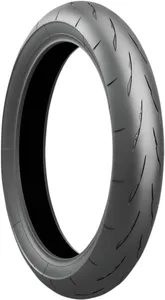
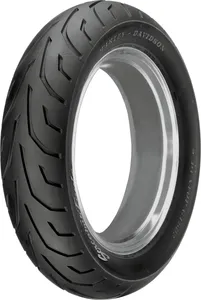
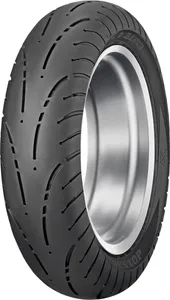
Road tyres in stock now
If the date code's done or the sidewalls are cracked, these are the road-going replacements people buy most.
Browse all road tyres →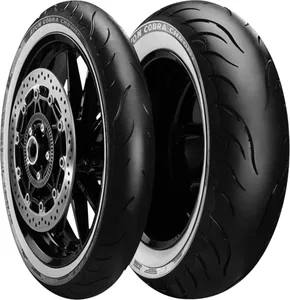
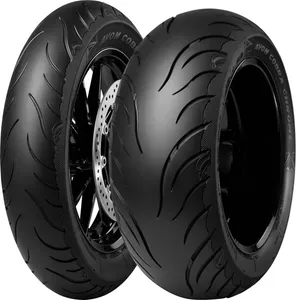
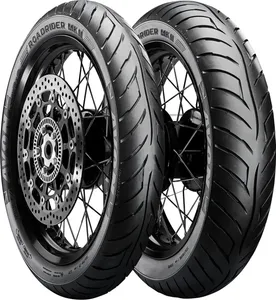
Find your replacement
When in doubt, replace it
Browse the catalogue by your bike, by the size on the sidewall, or talk to us. Free UK delivery on orders over £100, dispatched the same or next working day from current stock.
3,502 tyres · 29 brands