/ Guide
How to read a motorcycle tyre size
The code stamped on your tyre sidewall tells you everything that fits — width, profile, construction, wheel size, how much weight it carries and how fast it can be safely run. Here's what each part means.
Every motorcycle tyre carries a code on the sidewall that tells you its width, profile, construction, wheel size, how much weight it can carry and how fast it can be safely run. Once you can read it, fitment stops being a guessing game.
Here’s the full code with each part labelled.
The rest of this guide walks through each part in turn, with the bits people actually get wrong called out as we go.
Width — the first number (180)
The first number is the tyre’s section width in millimetres, measured across the widest point of the tread when fitted to its recommended rim. So 180 means the tyre is 180mm across.
Wider isn’t automatically better. A wider tyre at the same aspect ratio is taller (the sidewall is a percentage of the width), which lifts the bike and slows the steering. It also eats clearance to the chain, swingarm and hugger. Most bikes have an OE size for a reason. The chassis is set up around it.
The most common motorcycle widths are 110, 120, 130, 150, 160, 170, 180, 190 and 200mm. Front tyres skew narrower; rears carry the load and skew wider.
Aspect ratio — the second number (55)
The number after the slash is the aspect ratio, expressed as a percentage of the width. So 55 on a 180-section tyre means the sidewall is 99mm tall (55% of 180).
Lower aspect ratio means a shorter, stiffer sidewall. That gives sharper turn-in, more direct feedback through the bars and less squirm under hard braking. The trade-off is a harsher ride and less compliance on rough surfaces.
Sport bikes typically run 55 or 50. Sport-touring sits around 55 or 60. Cruisers and tourers go to 70, 80 and even 90 — taller sidewalls that absorb road imperfections and feel softer over distance.
Construction — the letter (R / B / -)
The letter that follows is the construction code:
- R = radial. The dominant pattern on modern road bikes from sport tourers up. Cord plies run bead to bead at 90 degrees to the rim, with steel or aramid belts under the tread. Better grip and lower rolling resistance than bias construction, and runs cooler at sustained speed.
- B = bias-belted. Diagonal cord plies with belts under the tread. Common on cruisers, retro bikes and some adventure tyres where stiff sidewall feel is wanted.
- No letter = bias-ply (cross-ply). Diagonal cords, no belts. The traditional construction, still found on classic, custom, off-road and many small-capacity bikes.
You’ll also see ZR as a combined construction-and-performance designation — radial, originally over 240 km/h capable, now used alongside an explicit speed letter on high-performance tyres.
Wheel diameter — the third number (17)
The third number is the wheel diameter in inches. Always inches, never millimetres. So 17 means the tyre fits a 17-inch rim.
This is the only number in the code that has to match exactly. You can sometimes vary width, profile or even speed rating within manufacturer guidance — you cannot fit a 17-inch tyre to an 18-inch rim. The bead won’t seat, full stop.
Common motorcycle wheel sizes:
- 17 inch — sport, sport-touring, naked, modern adventure rear
- 18 inch — classic, retro, mid-weight cruiser, motocross rear
- 19 inch — modern adventure front, retro front, some scramblers
- 21 inch — enduro and adventure front, when off-road bias is the priority
- 15 / 16 inch — heavyweight cruiser, scooter
- 10 / 12 / 13 inch — scooter, moped
Load index — the digits in brackets (73)
The two- or three-digit number inside the brackets is the load index. It’s a standardised reference number that maps to a maximum carrying weight in kilograms.
A few common motorcycle values:
- 66 = 300 kg
- 69 = 325 kg
- 73 = 365 kg
- 75 = 387 kg
- 80 = 450 kg
- 85 = 515 kg
Front tyres typically have a lower load index than rears because the bike’s weight bias and the rider’s mass sit further back. Fitting a tyre with a load index below the OE figure shrinks your structural margin, especially two-up or with luggage. Going higher is fine, going lower is not.
Speed rating — the letter (W)
The letter after the load index is the speed rating. It’s the maximum speed at which the tyre can safely carry its rated load. The full alphabetical scale goes well past anything road-legal, but the letters you actually see on motorcycle tyres are these:
| Letter | km/h | mph | Where you'll see it |
|---|---|---|---|
| M | 130 | 81 | Mopeds, small scooters |
| P | 150 | 93 | Larger scooters, learner bikes |
| S | 180 | 112 | Some classic and custom tyres |
| T | 190 | 118 | Light cruisers, smaller capacity |
| H | 210 | 130 | Touring, cruiser, off-road |
| V | 240 | 149 | Sport-touring, naked |
| W | 270 | 168 | Sport, performance sport-touring |
| (Y) | 300+ | 186+ | Hyperbike, track-focused |
Higher isn’t automatically better. Speed-rated tyres often use harder compounds and stiffer carcasses to handle the heat at speed, which can mean slightly less wet grip and a longer warm-up. Match or exceed your bike’s OE rating. Don’t chase letters several rungs above what you’ll ever use.
The extras: M/C, RFD, M+S, TL/TT and more
Beyond the main code you’ll find a scatter of letters and symbols:
- M/C = motorcycle. Confirms the tyre is built for two-wheel use. Some sizes overlap with car tyres; this stamp is what proves it’s the right tyre.
- TL = tubeless. TT = tube-type. Some bike tyres are dual-rated and carry both. Match the wheel — a tubeless rim takes a tubeless tyre and runs without an inner tube.
- RFD or REINF = reinforced. Stiffer carcass, higher load index for the same size, useful for heavily-laden tourers and pillion-with-luggage setups.
- M+S = mud and snow. Loose UK winter context — the marking is car-tyre derived and rare on bike tyres outside genuine adventure or dual-sport rubber.
- A directional arrow — on the sidewall, marked “ROTATION”. Many tread patterns are designed to channel water one way; fitted backwards, wet grip drops sharply. Always fit in the marked direction.
- F / R — front or rear. Some tyres only fit one position; some are sold as matched front-and-rear pairs.
- DOT date code — a four-digit number inside an oval. Week of manufacture and year. See the age guide for why this matters.
Why you can’t always just go up a size
Manufacturers spend years dialling in the tyre size for each bike. The width, profile, contact patch shape, sidewall stiffness and load index all interact with how the chassis is set up.
Going wider or taller without checking changes:
- Steering speed. A taller tyre slows the steering and pushes the front end up, altering rake and trail.
- Speedometer accuracy. UK speedos are calibrated against the OE rolling circumference. Change the diameter and your indicated speed drifts from your actual speed.
- Clearance. Hugger gap, swingarm width, chain run, fork travel — all set around the OE size. A wider tyre can rub at full lock or under heavy braking compression.
- Load and speed margin. Drop the load index or speed rating and you’ve quietly removed safety margin without any visible change.
The owner’s manual lists the sizes the manufacturer approves. Some bikes have a “preferred” plus an “alternate” size; some have only one. If you’re tempted by something off-list, ring the manufacturer’s technical line or email us — we’ll cross-reference what’s safe.
Quick: where to look on your bike
Three places, in order of trust:
- The owner’s manual. Authority. Lists OE sizes for front and rear, plus any approved alternates.
- The sidewall of your existing tyre. Tells you what’s actually fitted right now, which may or may not match OE.
- A sticker on the chassis or swingarm. Some bikes carry one; some don’t. Useful as a quick reference but the manual wins if there’s a conflict.
If you’ve checked all three and you’re still unsure, drop us a message before ordering. Better five minutes on email than a tyre you can’t fit.
Common 17-inch road sizes
Once you've decoded yours, here's what's in stock right now in the road-tyre family — sport, sport-touring, naked.
Browse all road tyres →
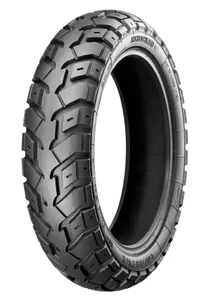
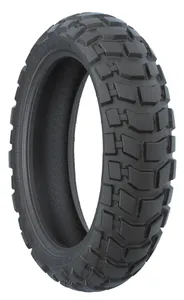
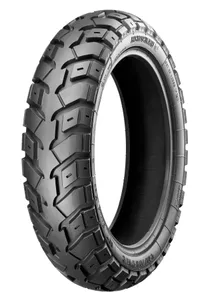
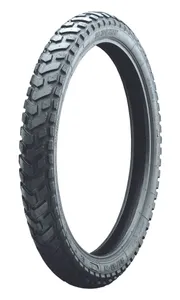
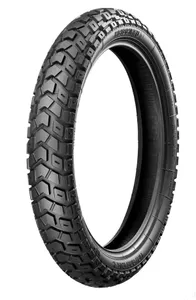
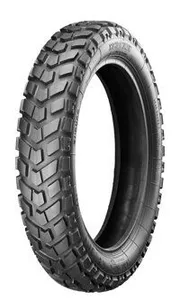
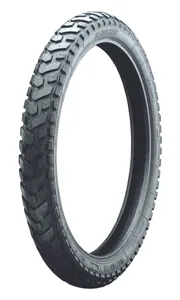
Adventure & dual-sport
17 and 19 inch fronts mostly. Heavier load indices than pure road tyres.
Browse all adventure & dual-sport tyres →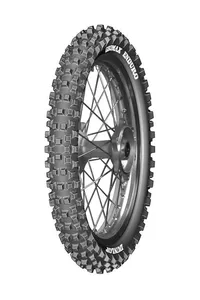
Find your size
Search by the size on the sidewall
Once you've decoded yours, jump straight to tyres in that size. Or browse by your bike if you'd rather start from the other end.
3,502 tyres · 29 brands